




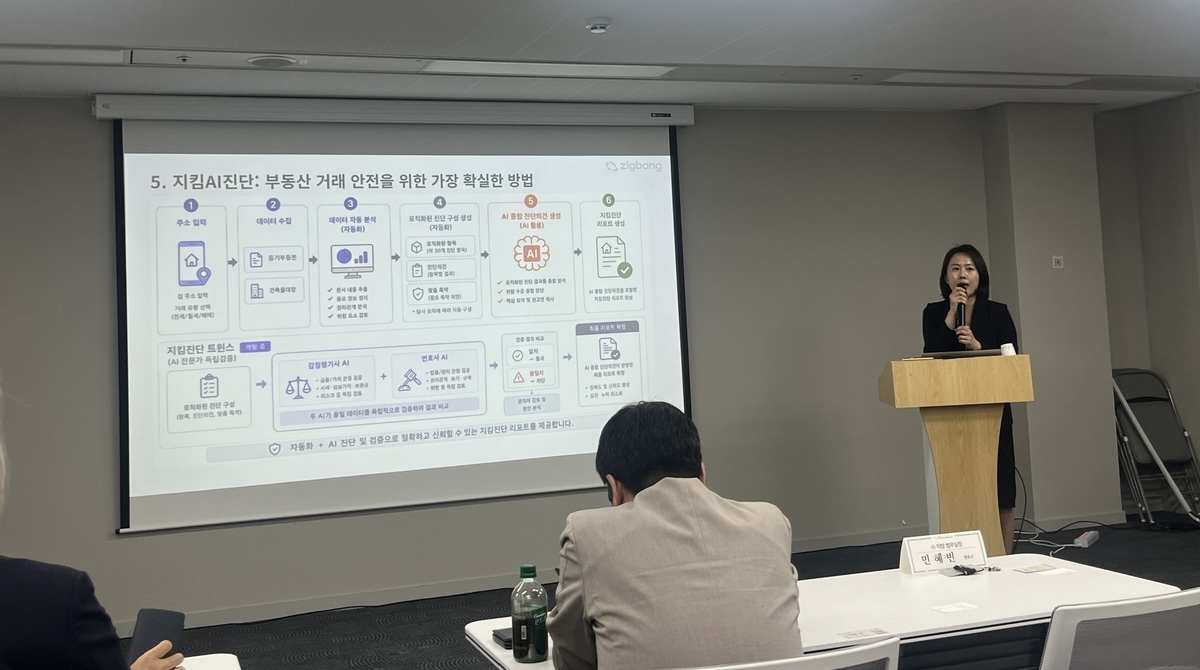
Zigbang launches the Zikim AI diagnostic service designed to prevent jeonse fraud. It was introduced at a public-private seminar hosted by the National AI Strategy Committee at Seoul Square in Jung-gu, Seoul.
Jeonse fraud which is a Korean lease system requiring a large lump-sum deposit instead of monthly rent. The Zikim AI Diagnosis service uses AI to analyse property registration records, building ledgers, and market price data to assess transaction risks.
“Jeonse fraud is not merely an individual transaction risk, but an issue directly tied to platform trust and user protection.”
Min Hye-bin, Head of the Legal Office, Zigbang
PropTech firms are moving beyond simple property brokerage and entering a competition to build ‘safety infrastructure’ that filters out transaction risks in advance. Zigbang’s Zikim AI Diagnosis also focuses on providing supporting pre-contract decision-making, going beyond after-the-fact defences centred on contract reviews.
The Zikim AI Diagnosis service analyses whether a building is in violation of regulations, it also examines legal rights including mortgages, seizures, trusts, and leasehold registration orders.
It also looks at histories of deposit non-return, chronic tax delinquency, and eligibility for deposit guarantee insurance. The service additionally provides public safety data such as nearby crime records.
“In real estate transactions in particular, there is a structure in which contracting parties are led by brokers. We needed an ecosystem where tenants themselves can ask, ‘Please add this special clause,’ or ‘There is a mortgage on this property, what should I do?'”
Min Hye-bin, Head of the Legal Office, Zigbang
Unlike apartments, studio units and villas could be vulnerable to jeonse fraud as their market prices are difficult to gauge and their rights structures are complex, according to the analysis.
Zigbang has expanded its services from ‘Zikim Brokerage’, which establishes joint liability with brokers, through ‘Zikim Diagnosis’, which provides contract reports to this AI-based automated diagnosis system.
“We are expanding support to standardise AI- and big data-based risk analysis in order to block risks before contracts and help ensure safe decision-making.”
Seoul Metropolitan Government
The industry sees this trend spreading beyond private services to public safety nets as well. Since March, the Seoul Metropolitan Government has grown its AI-based ‘Jeonse Fraud Risk Analysis Report’ service from 1,000 cases to 3,000 cases.
This service allows AI to predict jeonse fraud risk by analysing landlord and property information once an address is entered. A unique feature is that AI estimates and displays the scale of senior-priority deposits on multi-household homes and the possibility of multiple property ownership.
“For accurate diagnosis, comprehensive public data is needed, including not only property registration but also confirmed date records, resident registration inquiries, and tax payment certificates, but there are many constraints for private companies to utilize them. We will work with the Ministry of Land, Infrastructure and Transport to open up more public infrastructure.”
Min Hye-bin, Head of the Legal Office, Zigbang
The industry believes that opening and standardising public data are essential for AI-based jeonse fraud prevention services to function more precisely.